Does Regence Cover TMS, Counseling, and Spravato in Washington?

Ashley Keays • June 30, 2026

Quick Answer: In most cases, yes - Regence plans in Washington commonly cover all three when they're medically necessary. But the details depend on your specific plan. TMS and Spravato generally require prior authorization (documentation that other treatments haven't worked well enough), and counseling is typically covered with a behavioral-health diagnosis. The only way to know your actual out-of-pocket cost is a benefits check - which we do for free.


Regence is one of the most common insurers we see among Washington patients, so if you have a Regence plan and you're weighing TMS, counseling, or Spravato, this is a fair and important question. Here's how coverage generally works for each - and how to find out exactly what your plan will pay.


Does Regence cover TMS?


Generally, yes. Most major commercial insurers in Washington, including Regence plans, cover TMS for treatment-resistant depression. The key word is treatment-resistant: coverage usually requires a prior authorization, which is a formal request your clinic submits showing you meet the plan's criteria - typically a documented history of trying multiple antidepressants without enough relief.


That prior-authorization step is where a lot of approvals are won or lost. A well-prepared submission, with your medication history and clinical records documented the way the insurer expects, significantly improves your odds. At Creative Wellness, this is part of what we do: we verify your coverage, review your medication history, prepare the authorization, and if a claim is denied, we work through the appeal with you rather than walking away.


The most helpful thing you can do is arrive at your evaluation with as complete a medication history as possible - notes, pharmacy records, or discharge summaries from previous prescribers all strengthen the submission.


Does Regence cover counseling and therapy?


Typically, yes. Insurance companies widely recognize counseling as a core mental-health service, and Regence plans generally cover therapy when there's a qualifying behavioral-health diagnosis. Coverage specifics - copays, session limits, whether a referral is needed - vary by plan, so this is another case where a quick benefits check gives you a clear answer.


If your plan doesn't cover counseling, or you'd rather not use insurance, self-pay is straightforward: counseling sessions at Creative Wellness are $180 for 60 minutes.


Does Regence cover Spravato (esketamine)?


Often, yes, with conditions. Spravato is FDA-approved for adults with treatment-resistant depression, and many plans - including Regence plans - cover it for patients who meet that criteria. Because Spravato is administered in-clinic under medical supervision, coverage usually involves prior authorization and eligibility screening before treatment begins. Our team handles that screening and the insurance side for you, the same way we do for TMS.


As with the others, the exact answer depends on your specific plan, so verifying benefits up front is the way to avoid surprises.

We Accept Insurance

Take a quick 1-minute quiz  to check if you meet typical insurance criteria for TMS. It’s an easy way to see if you may qualify - no pressure, no commitment. If you're exploring other treatments or just want to talk it through, Get in touch. We're here to help you understand your benefits and next steps.


Eligibility Quiz

How to check your specific Regence benefits


You have two routes:


Check it yourself. Have your plan details handy (plan name, group number, member ID). Call the number on the back of your card and ask specifically: Is TMS / outpatient therapy / Spravato covered under my plan, and what are the prior-authorization requirements? Ask about your deductible and copay while you're at it.


Let us check for you. We do free benefits checks. You give us your insurance information, and we come back with what your plan covers and what to expect - no obligation. For most people this is the faster, clearer route, since we know what to ask and how to read the answer.


If it turns out you're not covered


Coverage gaps happen - a high deductible, an out-of-network plan, or a denial. If that's where you land, you're not out of options. We offer self-pay pricing (a full TMS course is $5,000, and counseling is $180 per hour) and flexible financing, so cost is less likely to be the thing that stops you. And if a TMS claim is denied, the appeal process is real and often worth pursuing - we'll advocate on your behalf where the clinical evidence supports it.

  • I have Regence but I'm not sure which plan. Can you still tell me what's covered?

    Yes — give us your insurance details and we'll run a free benefits check to confirm your specific plan's coverage for whichever service you're considering.

  • How long does prior authorization take for TMS or Spravato?

    It varies by plan and how complete the documentation is. A well-prepared submission moves faster, which is exactly why we gather your medication history and records carefully before submitting.

  • Does Regence cover TMS for conditions other than depression?

    Coverage is most established for treatment-resistant major depressive disorder. For other conditions, coverage varies and may be limited, so a benefits check is the only reliable way to know for your plan.

  • What if my Regence plan only covers part of the cost?

    Partial coverage is common, especially if you haven't met your deductible. We'll show you the likely out-of-pocket figure up front, and self-pay and financing options are available to fill the gap.

Not Sure Where to Start? We Can Help

With so many treatment options, finding the right one can be overwhelming. Let’s make it easier. Answer a few quick questions, and we’ll help you discover what might work best for you

Take the Quiz →
Three people standing and talking in a sunlit forest among tall trees
By Ashley Keays June 30, 2026
Not sure if your teen needs therapy? A parent's guide to the signs, choosing the right therapist, and getting a reluctant teen through the door. Olympia, WA.
Two people talking across a desk in a bright office, with papers, a laptop, and shelves in the background.
By Ashley Keays June 30, 2026
Divorce, a move, a career change, or a new chapter? Therapy helps you process the transition and figure out what comes next. Counseling in Olympia, WA. (151 characters)
Four people talking around a counter in a bright office, with a laptop and monitor displaying a presentation.
By Ashley Keays June 26, 2026
Quick Answer : CBT (cognitive behavioral therapy) for adult ADHD is structured, skills-based talk therapy that targets the daily problems ADHD actually creates - time management, organization, follow-through, and the self-critical thinking that piles up over years. Medication can turn up focus and dial down impulsivity, but it doesn't teach those skills. For many adults, the two work best together. If you've started medication for ADHD and found that you can focus better but still can't seem to get the laundry folded, answer that email, or stop calling yourself lazy, you're not doing it wrong. Medication and therapy solve different parts of the problem. This post covers what CBT for adult ADHD targets, why a pill alone often isn't the whole answer, and how the two fit together. What medication does well - and what it doesn't For a lot of adults, ADHD medication is genuinely useful. It can reduce the core symptoms: the wandering attention, the restlessness, the impulsive decisions. When it works, the volume on those symptoms comes down. But medication doesn't teach skills. It won't build you a system for tracking deadlines, break the habit of starting five things and finishing none, or undo years of believing you're the problem. Those are learned patterns, and learned patterns respond to practice, not chemistry. That gap - between "I can focus now" and "I still don't know how to run my life" - is exactly where CBT comes in. This isn't an argument against medication. Many people do best with both. It's just that they're built to do different jobs. What CBT for adult ADHD actually targets Regular talk therapy often explores feelings and history. CBT for ADHD is more practical and present-focused. It works on the specific ways ADHD shows up in your week. Executive function and the daily logistics This is the heart of it. ADHD makes the "managing yourself" tasks harder: planning, prioritizing, starting boring-but-important things, keeping track of time, and following through. CBT for ADHD builds concrete tools for these - external systems for memory and deadlines, ways to break overwhelming tasks into startable pieces, and routines that don't rely on willpower you can't summon on demand. The goal is structure that works with an ADHD brain instead of fighting it. The thought patterns ADHD leaves behind Most adults with ADHD have spent years missing deadlines, losing things, and being told to "just try harder." That leaves a mark. A lot of people arrive with a running internal monologue - I'm lazy, I'm careless, something's wrong with me — that isn't accurate but feels like fact. The "cognitive" part of CBT is about catching those thoughts, testing them against reality, and replacing them with something truer and more useful. This matters because the shame and the symptoms feed each other. Emotional regulation and sensitivity to criticism ADHD isn't only about attention. Many adults also struggle with intense, fast-moving emotions and a strong reaction to perceived criticism or rejection. CBT can help you notice the spike sooner and respond instead of react, which tends to ease the friction in relationships and at work.
Therapist taking notes during a counseling session with a seated client in a bright office
By Ashley Keays June 26, 2026
Quick Answer: Finding the right therapist in Olympia comes down to matching three things: the kind of help you need (individual, couples, or family work), a therapist whose style and experience fit your situation, and the practical details - location, availability, cost, and whether they take your insurance. This guide walks through how to weigh each of those so you book with someone who's actually a good fit, not just the first name that comes up. Choosing a counselor can feel like one more hard decision at a time when you're already low on energy. The good news is that "the right therapist" isn't a single perfect person you have to hunt down. It's about a reasonable fit on a few specific things, and most of those you can sort out in a phone call or a first session. Here's how to narrow it down. Start with what you're actually looking for Before you compare therapists, get clear on the problem you want help with. "I've been anxious and can't sleep" points somewhere different than "my partner and I keep having the same fight." That clarity makes every later step easier. A few useful distinctions: Individual therapy - for things you're carrying yourself: depression, anxiety, grief, trauma, life transitions, self-esteem, or feeling stuck. Couples therapy - for the relationship itself: communication, recurring conflict, trust, or rebuilding connection. Family therapy - for patterns involving parents, kids, or the household as a whole. You don't need a diagnosis or a perfect description to start. But knowing roughly which category you're in helps you filter quickly, since not every therapist does all three. Types of therapy - and why fit usually matters more You'll see a lot of acronyms when you search: CBT, DBT, EFT, solution-focused, and more. They're real, and they matter, but for most people, the therapist matters more than the method. A quick orientation: Cognitive Behavioral Therapy (CBT) focuses on the link between thoughts, feelings, and behavior, and on changing unhelpful patterns. It's practical and often shorter-term. Solution-focused work zeroes in on the specific change you want and the steps to get there, rather than spending months on backstory. Couples and family approaches look at the patterns between people - how a conversation goes sideways, who shuts down, what each person actually needs. At Creative Wellness, our therapists draw on evidence-based approaches like these and tailor them to your goals rather than forcing you into one method. If you're curious how a session is actually structured, our counseling and therapy page covers what to expect. Questions worth asking before you book A short phone consultation tells you a lot. Most reputable practices offer one. Things worth asking: Do you have experience with what I'm dealing with? Depression, trauma, and relationship conflict each call for different experience. Do you work with individuals, couples, or both? Make sure they cover your situation. What does a typical session look like with you? You're listening for an approach that sounds like something you could actually do. In person, virtual, or both? Decide what's realistic for your schedule. What's the cost, and do you take my insurance or offer self-pay? Get the real number before you commit. If a therapist can't or won't answer these clearly, that's useful information too. Contact us here
Collage of workers inspecting a house, van, and equipment during a property repair visit
By Ashley Keays June 4, 2026
Quick Answer: Many TMS clinics in Washington offer TMS and very little else. Creative Wellness offers TMS , Spravato, counseling, medication management, and genetic testing under one roof, across our three Washington locations. For most patients, that means fewer providers to coordinate, faster adjustments when something isn't working, and a treatment plan that can flex as their needs change. When you start researching TMS in Washington, you'll find a lot of clinics offering it. On the surface, they look similar - same FDA-approved technology, same general process, similar pitch. The differences are harder to spot from the outside. One of the biggest differences is also one of the easiest to miss: what happens if TMS alone isn't enough. The TMS-only model: what most clinics look like The standard model in Washington is a clinic that does TMS and not much else. Maybe a consultation, maybe Spravato, but the core offering is the TMS course. For patients who respond well to TMS alone, this model works fine. You come in, you do your sessions, you finish your course, you feel better. The problems start when one of these is true: TMS doesn't work as well as hoped. Roughly half of TMS patients respond strongly. Others see partial improvement. Some need a different combination of treatments to get all the way there. You need medication adjustments during or after TMS. Many patients are on antidepressants when they start. The right next step is sometimes a tweak - but who handles that? Therapy would help alongside TMS. Research consistently shows therapy and TMS work better together for many conditions. But your TMS clinic doesn't offer therapy. A different treatment turns out to be a better fit. Sometimes the original plan needs to change — to Spravato, to medication management, to therapy, or to a combination. At a TMS-only clinic, the answer is the same in every scenario: "you'll need to see someone else for that." That means new referrals, new wait times, new intake paperwork, new providers who don't know your history. The Creative Wellness model: services that work together Creative Wellness offers TMS, but we also offer: Counseling and therapy - individual, couples, and family Spravato (esketamine) - for treatment-resistant depression Medication management - full psychiatric prescribing and monitoring Genetic testing- to guide medication choices through Tempus NeuroPsych TMS for teens (15 and up- the only FDA-approved use of TMS in adolescents, available through our NeuroStar device All of these are available through the same clinic, the same team, and the same patient file. That changes what happens when a treatment plan needs to shift.
Two people holding hands on a rocky beach by the ocean, facing each other under a cloudy sky
By Ashley Keays June 4, 2026
Quick Answer: Couples counseling at Creative Wellness in Olympia is led by Dr. David Simonsen, who has over 25 years of experience working with couples. Sessions are $180 for 60 minutes, available in person or by secure video, and focus on practical work - communication, conflict, trust, and shared goals - without fluff or judgment. Most couples don't come to counseling because everything is fine. They come because something has shifted - communication has gotten harder, the same arguments keep coming back, trust has been damaged, or they've drifted somewhere they didn't plan to be. Some couples are in crisis. Some just want to get back to feeling like a team. When couples counseling makes sense There isn't a single right moment to start. Some common reasons people get in touch: Communication has broken down. Conversations turn into arguments, or stop happening at all. One or both partners feel unheard. The same fight keeps coming back. You've talked about it. You've agreed to change. Nothing actually changes, and you're back in the same place a few weeks later. Trust has been damaged. Infidelity, dishonesty, broken commitments - and you're trying to decide if and how to rebuild. You feel like roommates, not partners. Physical and emotional connection has faded. You're going through the motions. A major life change is straining things. A new baby, a career change, an illness, a move, kids leaving home, retirement. Big transitions tend to expose cracks. You disagree on something fundamental. Money, parenting, intimacy, where to live, whether to stay together at all. You don't need to wait for things to be bad. Couples come for tune-ups too - to strengthen what's working and address small things before they become big ones.
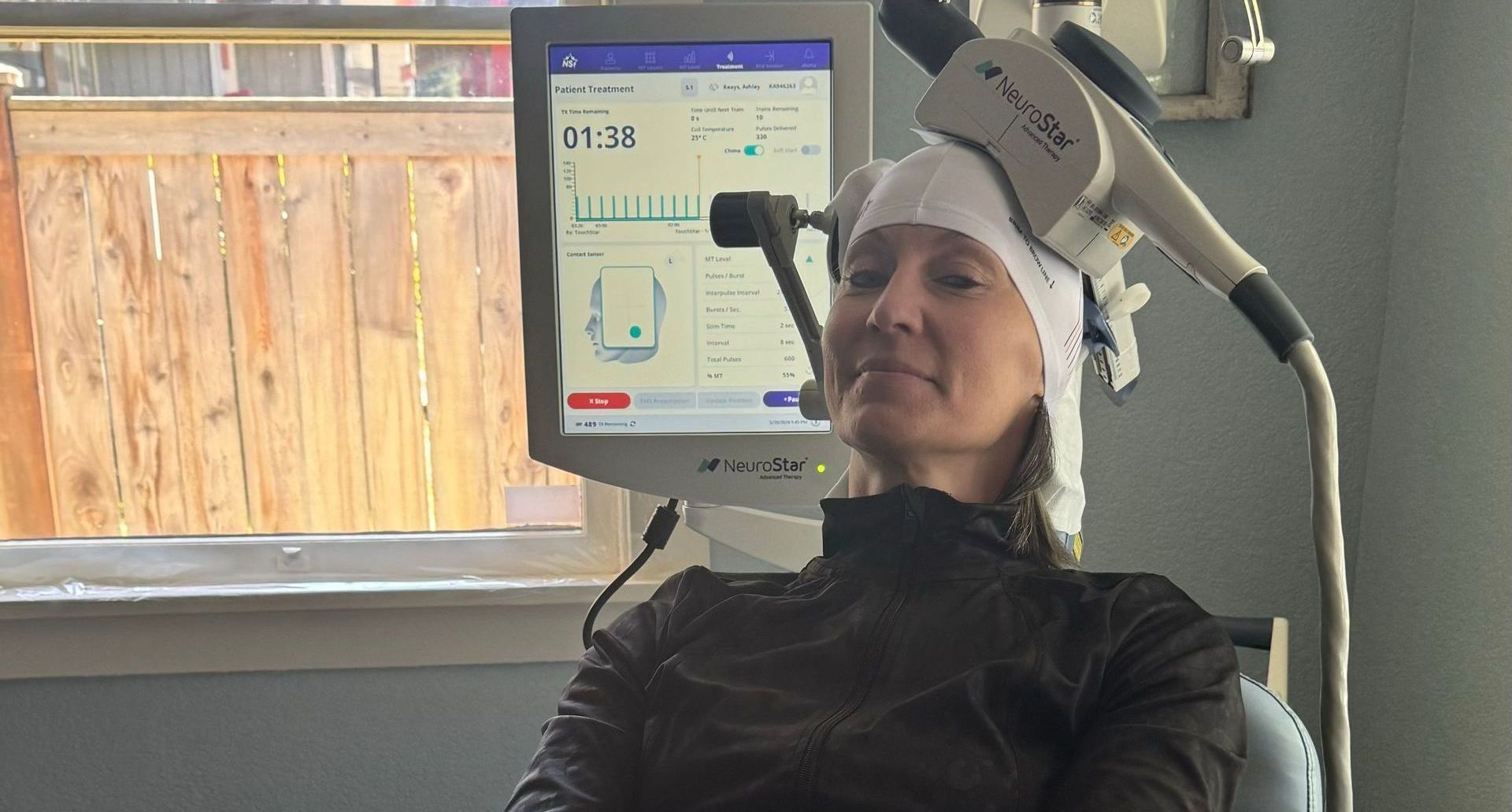
Woman in a gray cap sitting in a clinic chair beside a medical monitor and treatment device.
By Ashley Keays June 4, 2026
Quick Answer: A full course of TMS at Creative Wellness is $5,000 for 36 sessions ($150 per session). With in-network insurance and a successful prior authorization, most patients pay a few hundred to around $1,000 out of pocket. Patients with high deductibles or partial coverage usually land somewhere between $1,000 and $3,000. Without insurance, expect roughly $4,000–$7,000 depending on extras. We do free benefits checks before you commit to anything. Money is one of the first questions people ask about TMS - and it's one of the hardest to get a straight answer on. List prices and out-of-pocket costs are different numbers. What insurance pays varies wildly between plans. And the "average cost" figures you'll find online don't tell you what you, specifically, are going to pay. What you're actually paying for A TMS bill isn't one line item. It bundles several things, and knowing what goes into it makes the final number make more sense. The treatment course itself - daily sessions, usually 30 to 36 in total, over four to six weeks. This is the biggest part of the bill. An initial psychiatric evaluation - your first appointment, $250, to confirm TMS is appropriate and safe for you. Motor-threshold mapping - a one-time clinical step at your first session that personalizes the treatment to your brain. It sets the dose and target. Medication management follow-ups during treatment - $150 per session, covering follow-ups, medication adjustments, and monitoring. Facility and technician time - the chair, the device, the staff running each session. Optional extras - Tempus NeuroPsych genetic testing consultation ($250, with the test itself billed separately by Tempus and generally covered by insurance), Spravato consults if you're combining treatments. Maintenance or booster sessions later on - sometimes recommended after a course wraps up, and sometimes billed separately. A full course at Creative Wellness is $5,000 for 36 sessions - $150 per session . Each session is valued the same whether it's a mapping session to create your personalized protocol or a full treatment session. Learn More: What to Expect How insurance changes the math in Washington Most major commercial insurers in Washington cover TMS for treatment-resistant depression. They generally also require a prior authorization, which is a formal request your clinic submits proving you meet their coverage criteria = usually a documented history of trying multiple antidepressants without enough relief. Each plan handles TMS differently - same insurer, different policies — so the only way to know your specific number is a benefits check. We see Regence often in our patient base, and TriWest covers TMS for military families and dependents (including teens 15+ since the October 2025 expansion). We do these for free, before you commit to anything. You'll get a clear estimate of what your plan covers, what your deductible looks like, and what you'd realistically owe. Any Questions? Contact Us
By Ashley Keays April 29, 2026
Bipolar disorder has two sides - the highs (mania) and the lows (depression). For most people, the lows are where they spend most of their time, and the lows are usually what does the most damage to work, relationships, and day-to-day life. They're also the harder side to treat. Most bipolar medications are aimed at the highs, and many people try one after another for years without finding something that holds. TMS - a treatment that uses gentle magnetic pulses to the brain - is giving some of these patients a real option. But bipolar depression is trickier than regular depression, so we want to be straight with you about what TMS can and can't do, what the research actually shows, and how treatment works if you decide to try it. Is TMS approved for bipolar depression? Not yet. Right now, TMS is officially approved by the FDA for regular (non-bipolar) depression, for OCD, and for teens aged 15 and up with regular depression. For bipolar depression, doctors use it "off-label" - meaning it's allowed and widely used, but it doesn't yet carry a formal FDA approval for that specific condition. There has been a big step forward, though. In 2020, the FDA gave the NeuroStar TMS device - the one we use at Creative Wellness - something called a Breakthrough Device Designation for bipolar depression. That's the FDA saying, in effect: "This looks promising enough that we want to help it move through the approval pipeline faster." It's not full approval yet. But it's nothing either. Does it actually work? There's growing evidence that TMS can ease symptoms of bipolar depression - enough that the FDA granted NeuroStar (the device we use) Breakthrough Device Designation in 2020 to formally evaluate it for this use. Results vary from person to person. Some people respond well, some don't. We don't promise outcomes. What we can say confidently is that TMS is well-tolerated and safe for people with bipolar depression, without the systemic side effects that come with most bipolar medications.  One important note: there's some evidence that TMS can occasionally trigger a manic episode in a small number of bipolar patients. It's rare, but real - which is why we monitor closely throughout treatment. Before starting, an accurate diagnosis matters. Some patients have been labelled bipolar when the diagnosis isn't entirely clear, and a careful review sometimes identifies regular (unipolar) depression as the better fit, which changes the treatment plan and what insurance will cover.
Doctor in white coat working on a laptop at a desk, typing in a bright office
By Ashley Keays April 29, 2026
First responders carry something most people don't: the cumulative weight of traumatic events, repeated over years, absorbed as part of the job. The hypervigilance that keeps you sharp on a shift doesn't switch off when you go home. The images don't fade on schedule. Sleep gets harder. Reactions get bigger. Relationships get harder to hold onto. For many first responders, the symptoms build quietly for years before anyone names them. Some people call it burnout. Some call it stress. Clinically, it often meets the criteria for PTSD, treatment-resistant depression, or both. This post is about one treatment option that's increasingly being used for people in this situation: transcranial magnetic stimulation (TMS). This non-drug treatment works directly on the brain circuits driving these symptoms. Why first responders are at higher risk Working in emergency services is a recognised risk factor for PTSD . It sits alongside combat exposure, childhood trauma, and other situations where the brain gets pushed into survival mode repeatedly and struggles to come back down. Roughly 7 to 9% of people will experience PTSD at some point in their lifetime. For people in emergency services roles, the exposure is repeated and cumulative - it's not one big event but the tenth, the fiftieth, the hundredth. The math changes. One more thing to know: PTSD rarely travels alone. Roughly half of the people with PTSD also have depression. Anxiety, sleep problems, and substance use often come into the picture too. What might look like "just depression" or "just not sleeping well" is often something more layered. What's actually happening When you go through something life-threatening, your brain drops into a survival mode - hypervigilant, on edge, ready to react. Normally, once the danger passes, your brain returns to its usual state. With repeated or severe trauma, that reset doesn't fully happen. Certain pathways get stuck on high alert. The practical result is a brain that keeps sounding the alarm when there's no fire. That's the hypervigilance, the startle response, the inability to fully relax. It's not a character flaw or weakness. It's a biological pattern - and that means it's something that can be changed with the right treatment. What PTSD actually looks like The symptoms tend to fall into four groups: Intrusive thoughts - flashbacks, nightmares, distressing memories that show up without warning Negative mood and thinking - persistent fear, anger, guilt, or shame; feeling detached from people you used to feel close to; loss of interest in things you used to enjoy. Being constantly on edge - easily startled, struggling to sleep, trouble concentrating, irritability or aggression Avoidance - steering clear of anything that brings it back Any of these can make normal life harder - holding down a job, keeping relationships intact, making decisions, and getting proper rest. Left untreated, PTSD also raises the risk of depression, suicidal thoughts, and substance misuse. Will insurance cover it? It depends on the diagnosis and the insurer. For treatment-resistant depression, TMS is FDA-approved and covered by most plans when the paperwork supports it . For PTSD specifically, coverage is less consistent - some insurers approve it, others don't. When both are present, there's often a clear path to coverage through the depression diagnosis, with PTSD adjustments added during the same course. We check your coverage upfront and are straight with you about costs either way. No surprises.
Two people sit in chairs facing each other, reviewing a document together in a home office setting.
By Ashley Keays March 31, 2026
For most patients, the insurance approval process for TMS is a black box. You submit information, wait, and eventually hear yes or no - often without a clear understanding of what happened in between or why the decision went the way it did. That lack of visibility is a problem because what happens behind the scenes matters. A well-prepared prior authorization submission significantly improves the likelihood of approval. A poorly documented one - or one that misses a specific insurer’s criteria - can result in a denial that takes weeks to appeal, delaying treatment the patient genuinely needs. Why TMS Requires Prior Authorization TMS is an FDA-approved treatment, but FDA approval and insurance coverage are entirely separate things. Insurers make their own coverage determinations based on their own clinical policies, which vary by provider and are updated periodically as the evidence base evolves. Most major insurers in Washington now cover TMS for treatment-resistant major depressive disorder, but they require prior authorization - a formal request from the treating clinic that demonstrates the patient meets their specific eligibility criteria before treatment begins. This is standard for any high-cost or specialist treatment, not unique to TMS. The keyword is “before.” Starting treatment without authorization in place is a significant financial risk. If coverage is denied after treatment has begun, the patient may be liable for the full cost. A clinic that allows this to happen is not doing its job. What Insurers Typically Require Each insurer has its own coverage policy, but most share a common set of core requirements. Understanding these in advance helps you arrive at your evaluation with the right history documented. Diagnosis T MS is covered fo r major depressive dis order (MDD) and, with some insurers, OCD . The diagnosis must be formally documented by a qualified clinician. Off-label uses - anxiety, PTSD, and others - are generally not covered, though this varies and is worth checking with your specific insurer. Prior medication trials Most insurers require documented evidence that the patient has tried and failed to respond to a minimum number of antidepressants - typically two to four, from different drug classes, at adequate doses and durations. “Failed to respond” means either no meaningful improvement or side effects that made the medication intolerable. This documentation needs to be specific: drug names, doses, duration, and outcome. Symptom severity Insurers typically require evidence of moderate to severe depression, usually demonstrated through a validated rating scale score. This is part of why the clinical evaluation matters - it generates the baseline data that supports the authorization request. Prior psychotherapy Some insurers also require documented evidence of prior psychotherapy, typically a course of CBT or equivalent. This requirement is not universal, but it appears in enough coverage policies that it is worth checking early. Medical necessity statement The treating clinician must provide a written statement explaining why TMS is medically necessary for this specific patient, given their history and current presentation. Vague or generic statements are a common reason for denials. The documentation needs to tell a clear, specific clinical story.