TMS for First Responders in Washington State

First responders carry something most people don't: the cumulative weight of traumatic events, repeated over years, absorbed as part of the job. The hypervigilance that keeps you sharp on a shift doesn't switch off when you go home. The images don't fade on schedule. Sleep gets harder. Reactions get bigger. Relationships get harder to hold onto.
For many first responders, the symptoms build quietly for years before anyone names them. Some people call it burnout. Some call it stress. Clinically, it often meets the criteria for PTSD, treatment-resistant depression, or both.
This post is about one treatment option that's increasingly being used for people in this situation: transcranial magnetic stimulation (TMS). This non-drug treatment works directly on the brain circuits driving these symptoms.
Why first responders are at higher risk
Working in emergency services is a recognised risk factor for PTSD. It sits alongside combat exposure, childhood trauma, and other situations where the brain gets pushed into survival mode repeatedly and struggles to come back down.
Roughly 7 to 9% of people will experience PTSD at some point in their lifetime. For people in emergency services roles, the exposure is repeated and cumulative - it's not one big event but the tenth, the fiftieth, the hundredth. The math changes.
One more thing to know: PTSD rarely travels alone. Roughly half of the people with PTSD also have depression. Anxiety, sleep problems, and substance use often come into the picture too. What might look like "just depression" or "just not sleeping well" is often something more layered.
What's actually happening
When you go through something life-threatening, your brain drops into a survival mode - hypervigilant, on edge, ready to react. Normally, once the danger passes, your brain returns to its usual state. With repeated or severe trauma, that reset doesn't fully happen. Certain pathways get stuck on high alert.
The practical result is a brain that keeps sounding the alarm when there's no fire. That's the hypervigilance, the startle response, the inability to fully relax. It's not a character flaw or weakness. It's a biological pattern - and that means it's something that can be changed with the right treatment.
What PTSD actually looks like
The symptoms tend to fall into four groups:
Intrusive thoughts - flashbacks, nightmares, distressing memories that show up without warning
Negative mood and thinking - persistent fear, anger, guilt, or shame; feeling detached from people you used to feel close to; loss of interest in things you used to enjoy.
Being constantly on edge - easily startled, struggling to sleep, trouble concentrating, irritability or aggression
Avoidance - steering clear of anything that brings it back
Any of these can make normal life harder - holding down a job, keeping relationships intact, making decisions, and getting proper rest. Left untreated, PTSD also raises the risk of depression, suicidal thoughts, and substance misuse.
Will insurance cover it?
It depends on the diagnosis and the insurer. For treatment-resistant depression, TMS is FDA-approved and covered by most plans when the paperwork supports it. For PTSD specifically, coverage is less consistent - some insurers approve it, others don't. When both are present, there's often a clear path to coverage through the depression diagnosis, with PTSD adjustments added during the same course.
We check your coverage upfront and are straight with you about costs either way. No surprises.
We Accept Insurance
Take a quick 1-minute quiz to check if you meet typical insurance criteria for TMS. It’s an easy way to see if you may qualify - no pressure, no commitment. If you're exploring other treatments or just want to talk it through, Get in touch. We're here to help you understand your benefits and next steps.





What treatment actually looks like
The structure is the same as TMS for depression:
- 5 sessions per week, for around 6 weeks
- Followed by a 3-week taper (gradually reducing session frequency)
- Each session is around 20 minutes
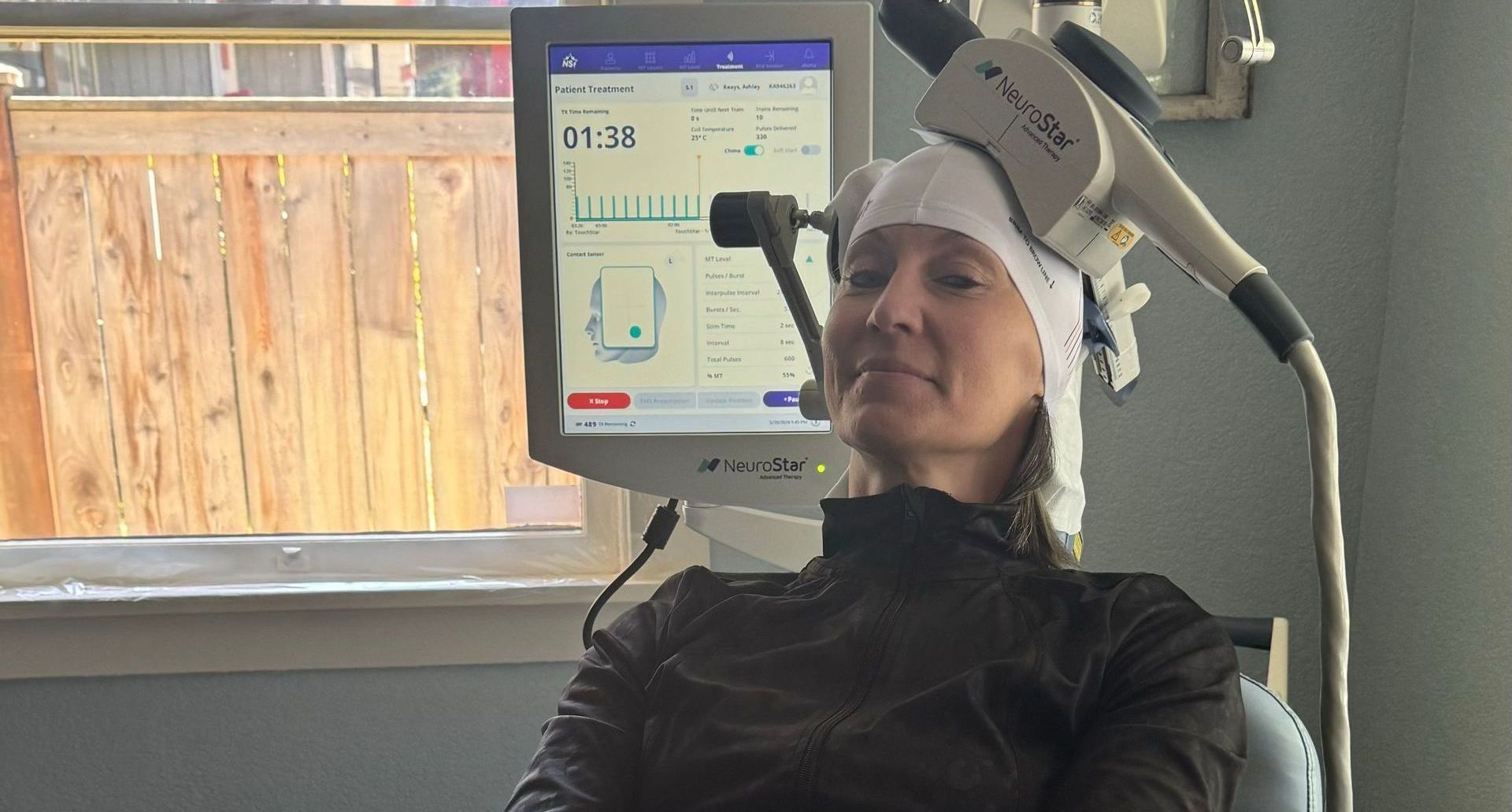
- You sit in a reclining chair, the coil rests against your head, and you feel a tapping sensation during the pulses
- You can drive, work, and go back to normal life right after
Some patients notice improvements within one to two weeks. Others take four to six weeks. Some benefit from adjustments to the protocol or additional sessions. Response is individualised - not everyone responds the same way, and we monitor closely throughout.
Who is and isn't a candidate?
You may be a reasonable candidate for TMS if:
- You've been diagnosed with PTSD, treatment-resistant depression, or both
- You've tried standard treatments (therapy, medication) without adequate relief
- You don't have a history of seizures or metal implants in or near your head
- You're in a stable enough place to commit to a daily treatment schedule for several weeks
TMS may not be the right fit if:
- You're in an active crisis that needs more immediate stabilisation first
- You have certain medical contraindications that the evaluation will screen for
Is TMS covered for PTSD?
Sometimes. It's FDA-approved and widely covered for treatment-resistant depression, but coverage for PTSD specifically varies by insurer. If you have both depression and PTSD, there's often a clear insurance path. We check your coverage upfront either way.
Can I keep working while I do TMS?
Yes. Sessions are around 20 minutes, there's no sedation, and you can drive yourself home afterward. The main commitment is the schedule — five days a week for six weeks, plus a taper.
How is TMS for PTSD different from TMS for depression?
The course structure is the same. The main difference is clinical: for PTSD, we often target the right side of the brain rather than the left, and we can use either inhibitory or excitatory protocols depending on which symptoms are dominant. If both depression and PTSD are present, we can address both.
What if I've already tried therapy and medication?
That's exactly the situation TMS is often considered for. It's particularly relevant for people whose symptoms haven't fully responded to standard treatments.